
An American doctoral student faces censorship
The first speaker is Jonathan Choi, a young doctoral student at Duke University, representing his co-authors from the Smithsonian Institute in Washington, D.C., specifically the Center for Bird Migration, the Department of Conservation Biology, and the National Zoo. At the start of his presentation, Jonathan announces that he is “formally prohibited from presenting the results of his thesis”—a directive imposed by his government. This situation, mentioned by several American researchers attending the One Ocean Science Congress (OOSC), was also highlighted during the congress’s opening ceremony and prompted a strong reaction from scientific leaders, who rallied to “save science,” sometimes at the expense of critical discussions on ocean conservation.
Although this situation is unusual in the scientific world, Jonathan continues his presentation emphatically and manages to distinguish his contribution from the previous ones by expressing genuine concern for biodiversity. He highlights the difficulty of reconciling “massive expansion of offshore wind power” with the “disruptive” ecological impacts on wildlife: cetaceans, bats, and birds. He points out that seabird populations have fallen by more than 35% since 1970 in the United States, and that the installation of offshore wind turbines could exacerbate the situation through collisions, the translocation of already vulnerable populations, and the alteration of migratory routes.
His study site—the Gulf of Mexico—faces specific threats that have rarely been mentioned in this panel before: intense commercial shipping traffic, industrial fishing, oil drilling, plastic pollution, and bioengineering projects focused on carbon capture. For Jonathan, the challenge is not so much to conquer the ocean in a race for maritime space (see Offshore Wind Power part 1) as to present it as a vulnerable environment that must be preserved.
He calls for coordination among US stakeholders—federal states, industries, researchers, NGOs—to implement an approach based on cumulative environmental impacts. Finally, he points out that the Gulf of Mexico, a major hub for the oil industry, is both a major source of ecological disruption and a bastion of resistance to renewable energy.
Modeling wind power: mathematics and ecosystems
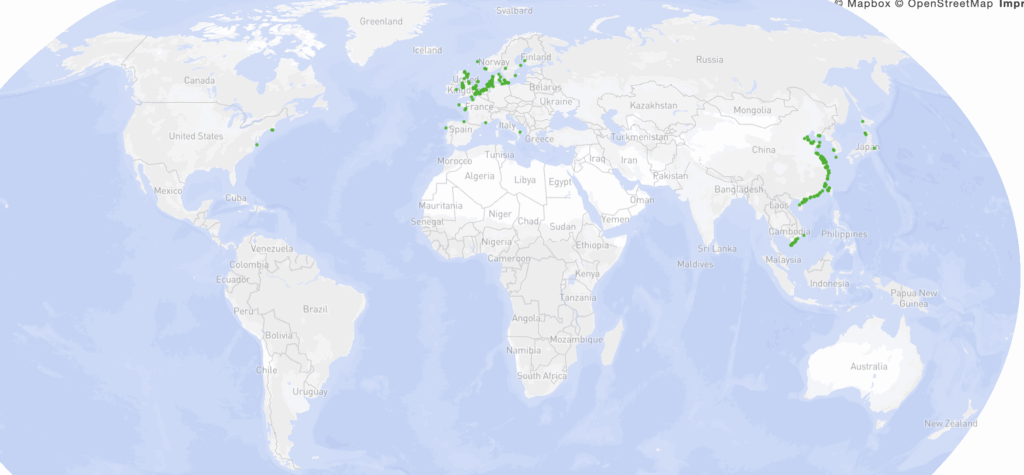
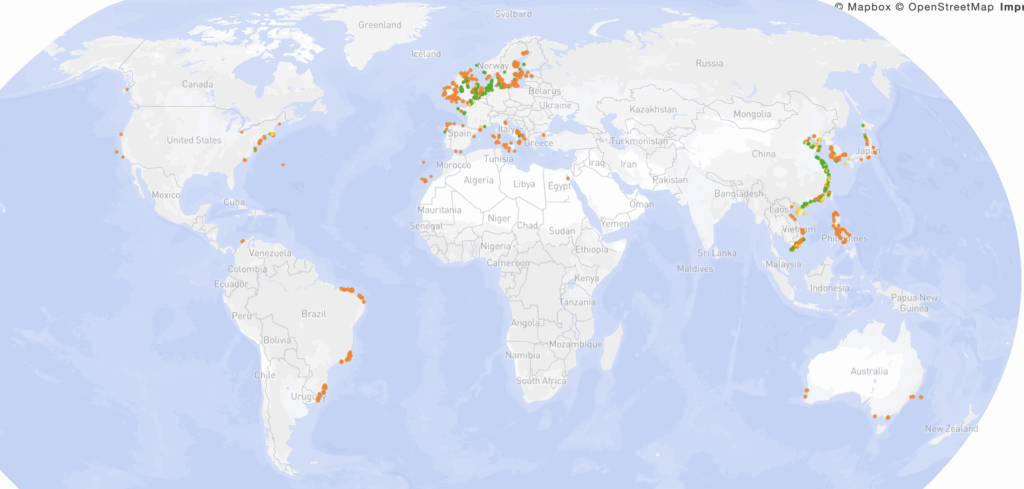
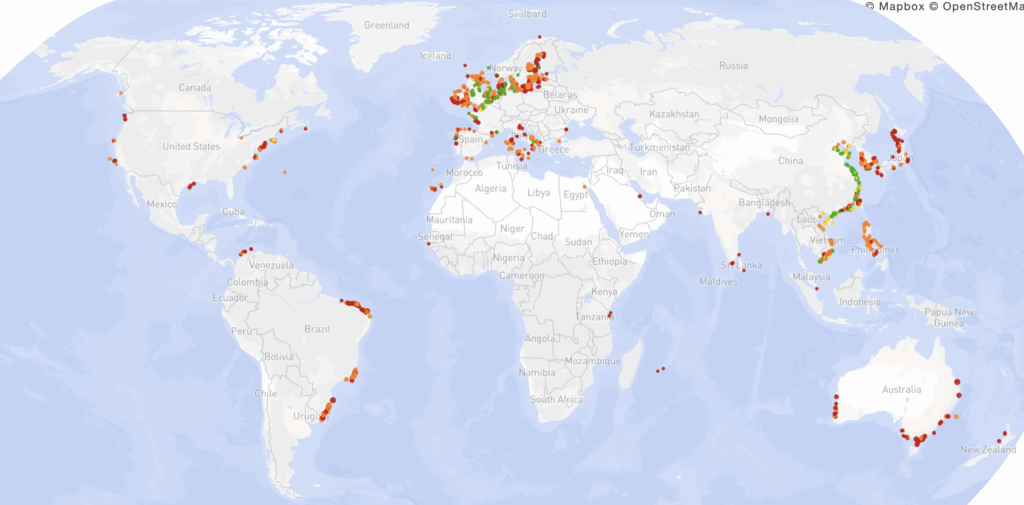
The next speaker, Yansong Huang, is a doctoral student in scientific ecology and represents a collective of French researchers [1]. His approach is based on mathematical modeling of trophic interactions in order to predict the effects of offshore wind power on marine ecosystems. I am already familiar with the work of his thesis supervisor, Ghassen Halouani, a researcher specializing in modeling “anthropogenic impacts” at sea (fishing, climate change, aquaculture, wind power) [2]. Yansong begins by situating his research, with the help of maps: “In France, offshore wind power development is mainly taking place in the English Channel,” he explains, more specifically “in the eastern Channel ecosystem,” and “its expansion is accelerating, with a projected capacity of 10 to 15.5 GW by 2050, covering up to 10% of the marine area of the zone.” He emphasizes the importance of examining “coexistence with other uses and human activities” and bases his work on taking into account multiple “pressures” on ecosystems.
He uses the OSMOSE model, an “individual” and “multi-species” tool based on “opportunistic predation.” This mathematical formalism makes it possible to work on the cumulative impact of offshore wind power after being calibrated and adjusted using data from twenty years of actual catches in the study area. “Opportunistic predation” then becomes more understandable, as it is a widely known phenomenon more commonly referred to as “fishing.” The predators in this story are therefore human fishermen who catch fish, shellfish, lobsters, etc. The data is described as “opportunistic” because it was not collected using a scientific protocol that would allow for accurate assessment of population sizes.
Yansong also incorporates into his models the impact of wind turbines via the resuspension of sediments, as well as the acoustic effects that cause avoidance behavior in many species. However, only fish seem to be considered in the rest of his presentation.
Yansong then presents various scenarios between now and 2050 that he has developed to understand the possible changes to the marine ecosystem with the deployment of offshore wind farms and fishing bans. He varies these two issues by distances from the coast and environmental protection zones for wind power, and for fishing, an optional closure: only for trawlers, for all fishermen, or without restriction. The results of his simulations show that offshore wind power will have a negative impact on biomass and fish catches. However, these effects could be offset by fishing restrictions. The social and governance issues that accompany these restrictive measures, and their implementation, are never mentioned. How do the various fishing communities view these possible restrictions? How do they participate in the negotiations and with what power? What are the repercussions of these restrictions on their activities (jobs, yields, fleets)? What are the sensitive expressions, symbolic repercussions, or affects associated with these policy directions? To name just a few…
An industrial vision of the energy transition
Claire Weller represents RWE, a German energy conglomerate operating on several continents (in Europe, the United States, Asia, and the Pacific). Her speech is resolutely focused on action and “solutions”: “Offshore wind power is a key lever for global decarbonization […] the best short-term mitigation.” She proudly mentions the projects currently underway: 3.3 GW installed at 19 European sites and nearly 20 GW under development worldwide. Among the projects mentioned are VISKA, Kittiwakery, SEAME, and SOFIA—some located in Thor (Denmark), the United Kingdom, and Germany.
She details RWE‘s commitments: “90% integration into a circular economy,” development of “innovative processes for cement recycling” (RECOBER project), and “training fishermen to maintain wind turbines” in the Baltic Sea (which it describes as an “opportunity for fishermen to become energy producers”). She also highlights projects in collaboration with academics aimed at “promoting marine biodiversity” through the creation of artificial habitats described as “innovative biodiversity positive.”
She concludes by discussing the implementation of “holistic” tools that aim to “articulate economic, environmental, and social issues for the benefit of local communities,” an ambition for which RWE is funded by the European Union.
The impossible reconciliation between biodiversity and offshore wind power?
The final presentation highlights the current impasse in European marine governance. Ben Boteler from the Potsdam Institute for Sustainability Research in Germany represents a colleague from his institute, another researcher from Utrecht University in the Netherlands, and two Norwegian colleagues from the Water Research Institute, all of whom are working on the CrossGOV project. The presentation focuses on the North Sea.
Ben Boteler highlights the deep tensions between renewable energy and biodiversity protection. The inconsistencies between various European directives—such as the RED III directive on renewable energy, the MSFD (Marine Strategy Framework Directive), the MPED (Marine Protected Areas Directive), and the Nature Restoration Regulation—perfectly illustrate this impasse. On the one hand, pressure to accelerate the deployment of offshore wind turbines is intensifying because it is presented as a “solution to European climate goals”; on the other hand, marine ecosystems, already fragile, are increasingly exposed to irreversible risks. In short, Europe’s decarbonization ambitions seem to clash head-on with the need to protect marine biodiversity.
Case studies conducted in Germany, the Netherlands, and Norway as part of the CrossGov project show different approaches. Germany is described as a “pioneer,” the Netherlands as “inclusive,” and Norway as “cautious.” Ben has to pause because a helicopter is maneuvering above the port, making his presentation inaudible… He continues, saying that the practices for calculating cumulative impacts seem to vary and the results do not allow for changes to the trajectories decided by industry.
Current governance mechanisms are unable to reconcile these two objectives. On the contrary, they often exacerbate tensions between public actors, industries, and scientists, each defending priorities that seem incompatible. The argument that it is possible to find a “win-win solution” between offshore wind power and biodiversity appears increasingly fragile in the face of emerging structural contradictions.
The group discussion is very short, with only half of the 30 minutes initially planned remaining. While the BAMBOO project presented by Brigitte Vlaswinkel and her proposal for solar/wind hybridization generated the most discussion (see Offshore Wind Energy part 1), the questions all focused on the impacts of the arrival of offshore wind power, either on biodiversity (seabirds, new light pollution) or on fishermen (other users were not mentioned, nor were residents). The final question on impacts was addressed to all speakers, prompting the various communities represented on the panel to express their implicit positions. The modelers emphasized the uncertainties of their models and the need for time to conduct their research “to gain a better understanding.” The representatives of industrial consortiums also support the development of knowledge, but this time to “guide developers” and to know the “right technology to use.” Although everyone minimizes or sidesteps the impacts on biodiversity, wind power and renewable energies are presented as “ecological compared to the oil industry,” while recalling the “climate emergency.” The music resumes and abruptly interrupts the final roundtable discussion, and the discussions continue in a more informal and private setting…
Conclusion
The second part of the OOSC wind energy panel therefore took a different tone. It highlighted the difficulties of reconciling the massive expansion of offshore wind power with the protection of both marine biodiversity and local fishing, without giving the territories where these technologies are physically deployed minimal visibility, by evoking the uses, expressions of the communities living there, and the links and forms of attachment to the places transformed by these technologies. While the previous speakers presented offshore wind power as an ideal solution for decarbonization and advocated the development of hybrid technologies in a race for increased ocean space, more nuanced discourses on the impacts on biodiversity and governance challenges emerged in the second part.
It is likely that competition for maritime space will result in increasingly intense conflict in the future between, on the one hand, the preservation of ocean environments and ocean governance methods, and on the other, industrialists seeking to exploit the sea – wind power being just one of five other panels dedicated to decarbonization, four of which are dedicated to geoengineering for physical and chemical carbon capture (see upcoming article from //Justine//).
– – –
[1] The final slide credits the funders, namely France Énergies Marines and the French National Research Agency (France 2030 program) via the NESTORE program.
[2] Nogues Quentin, Baulaz Yoann, Clavel Joanne, Araignous Emma, Bourdaud Pierre, Ben Rais Lasram Frida, Dauvin Jean-Claude, Girardin Valérie, Halouani Ghassen, Le Loch Francois, Loew-Turbout Frédérique, Raoux Aurore, Niquil Nathalie (2023). “The usefulness of food web models in the ecosystem services framework: Quantifying, mapping, and linking services supply,” Ecosystem Services, 63, 101550 (14p.).